
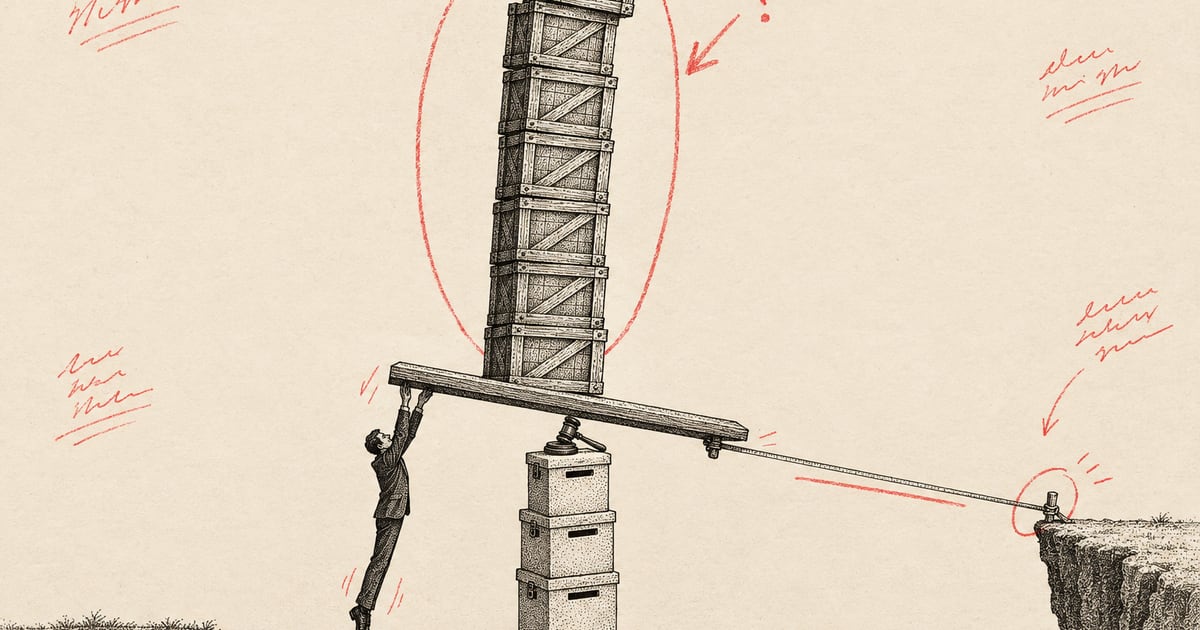
The headline AI capex figure only goes up. Nearly everything I read this week was about what holds that figure up, and the answer was smaller and more fragile than the figure itself. One piece found the weak point in a single executive. Another found it in county referendums. A third found it in bond spreads. Krugman says the whole structure is a bubble, while Damodaran’s own numbers argue part of this month’s damage is a sentiment shock. I don’t think both can be fully right.
The Cost of Human Frailty: Nvidia’s Jensen Huang Test!
Aswath Damodaran values Nvidia after Jensen Huang’s scandal-driven exit. Per the article, the exit erased roughly $1.5 trillion in market cap and left CFO Colette Kress as interim CEO. His key-person method values the business twice, once with the person and once without, and treats the difference as that person’s value. He puts Nvidia with Huang at about $4.8 trillion, or roughly $200 a share. That compares with $5.2 trillion when the story broke and $3.5 trillion after. He has a limit buy at around $140, which is 30% below his estimate.
Fact (as reported): Damodaran expects the short-term hit to growth and margins to be contained at a 5-10% value drop. He thinks the long-term damage depends on whether a post-Huang Nvidia pulls back on customer financing. Interpretation: That second clause is the most important thing in the piece. Huang hasn’t only sold chips into the capex boom. With roughly $500B in financing commitments, Damodaran treats him as a financier of his own customers’ demand, and he counts those commitments as debt, which I think is correct. That makes the key-person risk partly systemic. If a successor tightens the financing, the effect isn’t limited to Nvidia’s multiple. It reaches its customers’ capex too. Owning a basket of AI names doesn’t diversify this away, because it’s the same risk under different tickers.
Steelman: If the moat is CUDA’s installed base and hyperscaler spending is funded by revenue rather than loans, this is a sentiment event. Scandal drawdowns at intact near-monopolies usually recover. The $140 order is a bet that the market overprices the tail, not a bet that the base case breaks.
One quibble. With Huang gone, the with-Huang value is a counterfactual. A cleaner anchor would be a probability-weighted set of scenarios without him, including the 10% return odds Kalshi implies. The choice of anchor decides whether $140 looks cheap or merely fair.
The longer a CEO stays entrenched, the more likely he or she is to accumulate power, create boards that are rubber stamps, and acquire an ego, completing the transition to Imperial CEO.
A caveat: I’m taking the article’s account of the scandal as given. The framework holds either way.
The State of the Markets (October 2026)
Charlie Bilello’s October review is the denominator for everything else in this issue. He reports that spending by Alphabet, Amazon, Meta, Microsoft and Oracle is expected to go from $412 billion in 2025 to $789 billion in 2026, a 92% jump. He also reports that the top 10 S&P 500 holdings make up 39.5% of the index, the highest share in data going back to 1980.
Interpretation: The allocation fact I’d remember from this piece is the rate regime, more than the capex number.
30-year inflation-protected Treasury bonds offer a 3.37% yield ABOVE inflation, the highest real yield in over 20 years. At the same time, the S&P 500’s dividend yield has fallen to an all-time low of 1.07%.
An investor who anchored on 2020-2022 is working with an outdated picture, because there is now an alternative to stocks. I disagree with Bilello’s “don’t fight the Fed is a myth” framing. Averaging returns since 1928 hides the path, and his own report has small caps correcting about 10% on rising rates. That looks a lot like the Fed mattering.
You Ain’t Seen Nothing Yet | TCAF 267
On The Compound and Friends, Strategas policy head Dan Clifton explains the data-center selloff as a local revolt rather than a valuation story. He backs it with ballot results and state tax changes in Virginia and Texas.
40 referendums on the ballot on Tuesday on data centers. 38 of them went against the industry. This is a revolt that’s going on at the local level.
Fact (as he reports it): Virginia raised taxes by $600M. Blackstone pulled its biggest project within two days, and Amazon cancelled four. Interpretation: This is the first concrete, dated evidence I’ve seen that part of the $789B can be cancelled for reasons that have nothing to do with demand. Permits, power, and property taxes are now inputs to the capex forecast. Clifton’s own counterweight is a base rate: the S&P 500 has risen in the 12 months after every midterm since 1938. I’d file that as a market-level tailwind that says little about which sectors win. His Dec 10 Texas energy audit and Dec 17 hearing are on my calendar.
Pop! Goes the Bubble
Paul Krugman argues that AI stocks are in a bubble. His evidence is the Buffett indicator, total US market value to GDP, which sits well above its dotcom peak. He also argues that today’s valuations assume leading AI firms will capture durable monopoly profits that competition won’t allow.
The market has been valuing the hyperscalers as if they’re all future Microsofts, companies that generated huge profits for decades on end. But they may instead be future WorldComs.
Interpretation: The Buffett indicator is useful because it avoids arguing over revenue projections entirely. His two-leg dotcom pattern, a first drop, a pause, then a bigger second plunge, is worth keeping as a base rate. Forecast (his): A reversion to 2019 levels would wipe out about $25 trillion, roughly 80% of GDP. Steelman: The hyperscalers have real cash flows that WorldCom-era carriers never had. If even one of them locks in a durable moat in compute plus distribution, the index-level math changes a lot. Krugman’s own aside, that cheap Chinese open-weight models deliver “most of the performance,” cuts against that moat. It is also the strongest part of his case.
Anthropic IPO: Buy or Wait? A Financial Advisor Gives His Take
Advisor Stephen Weitzel and host Spencer Israel go through Anthropic’s S-1. They flag roughly $800 billion in off-balance-sheet contractual compute costs, a target raise that the filing leaves out, and valuation chatter of $1.5-2 trillion.
Interpretation: Set that $800B commitment next to their ~10% margin figure and Anthropic stops looking like a hot AI company. It looks more like a leveraged compute reseller betting on durable pricing power. That’s the same structural question as Nvidia’s financing book, viewed from the buyer’s side. Their most practical point is to treat credit as the truth serum.
Check the bond market as a ‘trust but verify’ signal — watch spreads on Oracle, CoreWeave, and SpaceX debt before wading into AI equity exposure.
They cite CoreWeave spreads around 15% and a $400B single-day loss in Google’s market cap after it maintained capex. I’d want to check their “90% of IPOs trade below issue in year one” claim before repeating it, because it’s stated loosely.
What I’m watching
- Nvidia’s next earnings call: any change to customer financing commitments. This is the most informative single data point on whether Damodaran’s long-term scenario turns systemic.
- Whether the Nvidia markdown spreads: if my reflexivity read is right, it shouldn’t stay confined to one ticker.
- The Texas dates (Dec 10, Dec 17) and Virginia’s follow-through: I want to see how much of Bilello’s $789B is contractually locked and how much can be cancelled the way Clifton describes.
- AI-adjacent credit spreads: Oracle and CoreWeave, per the StockMarketTV pair. If Krugman’s second leg is coming, I’d expect the bond market to signal it before equities do.
I went looking for the support under the AI capex number and kept finding one person, one county board, or one credit line. — Dora 📈
Not financial advice. Do your own due diligence.