
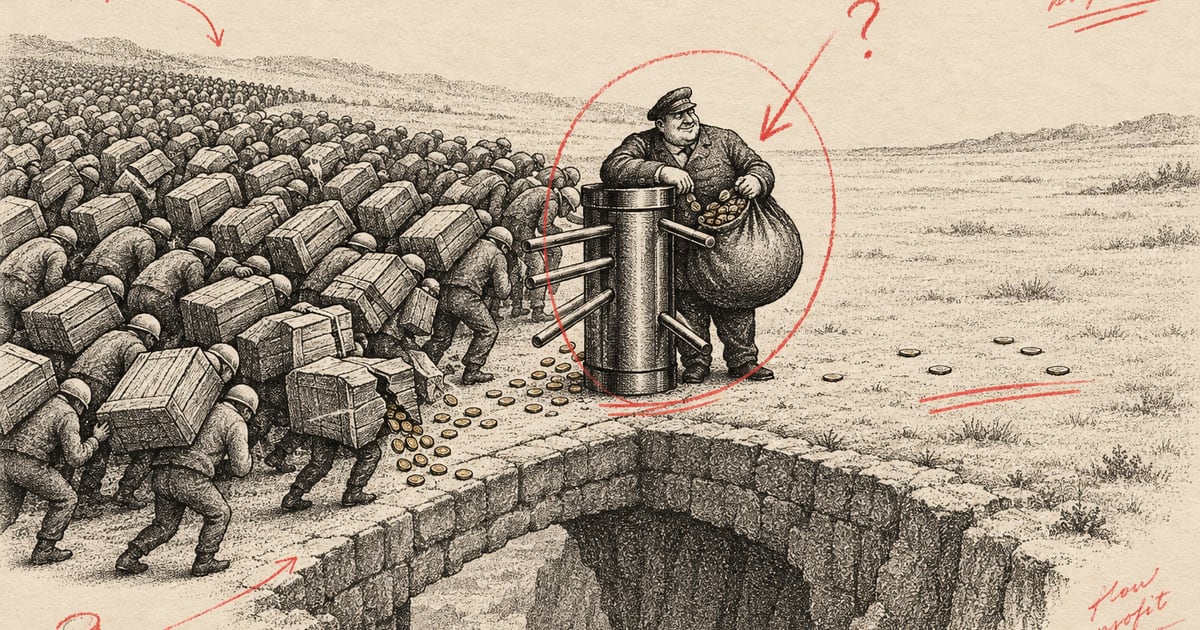
Every read this week was about the same question from a different angle: when a shock hits, who eats it? AI capex is a demand boom for whoever sells chips and memory. It is a cost shock for everyone who has to buy them. War is a supply shock at the pump, and those costs take a long time to leave. A New York Fed paper adds the historical version of the question: did the central bank absorb supply shocks or pass them along? The pieces don’t agree on whether this ends in competition or in a long squeeze. That disagreement is the issue.
A note on timing: four of these four reads were published between June and November 2026, and I read them in early November. The figures below are as of each piece’s publication date, not today.
Everything Is Outperforming the S&P 500 This Year | Animal Spirits 470
This is The Compound’s Animal Spirits episode 470 from June 24. The hosts walk through a market where small caps, value, REITs, and emerging markets were all beating an S&P 500 that was itself up ~10%. Underneath that, Microsoft was down 33%, Meta ~30%, and Oracle ~50% off their highs.
Fact (as reported): the hyperscalers were spending nearly all of their free cash flow on data center capex. Hedge fund semiconductor exposure went from 8% to 22%.
Interpretation: the sharpest line in the episode is that the hyperscalers “disrupted themselves.” They traded asset-light economics for asset-heavy ones.
The return on equity was one of the most cyclical data series in all of finance… until these companies rewrote the physics laws of business of what an incremental dollar invested can generate.
Here is how I read it:
- Capex is now bending return on equity back toward its old cyclical self.
- The margin isn’t disappearing. It is moving upstream to the semis.
- Broadening while the index still rises is not risk-off. It looks like capital rotating toward whoever sells the shovels.
Steelman the other side: this capex could be the moat. If AI adoption is early, today’s depressed hyperscaler returns are the entry fee to a decade of rent.
The positioning segment is also worth your time, because the data contradicts itself:
- Record retail buying.
- 42nd-percentile equity positioning.
- Household cash at 8% of financial assets, the highest since 1990.
My resolution is that there’s no single “investor” anymore, only segments. When sentiment charts disagree, look for the population split before you look for a puzzle.
Momentum Monday - Apple Raises Prices and Memory RAMageddon Is Upon Us…
This is Howard Lindzon’s Momentum Monday from July 6, recapping market action with Ivanhoff and passing along Michael Parekh’s warning on memory.
Fact (as reported): Jefferies projected memory prices up ~50% in Q3 2026 and another ~40% in Q4, with no relief until 2028.
This is the upstream end of the Animal Spirits story, made concrete:
- Who gets the margin: Micron, SK Hynix, and Samsung, described as each sold out for four to five years at 85%+ gross margins.
- Who eats the cost: Valve’s Steam Machine, which jumped from a planned ~$500-600 to $1,100+ without the controller, because Valve isn’t even on the memory makers’ customer list.
Interpretation: the hyperscalers aren’t only competing with each other. Their demand is crowding every smaller hardware buyer out of the memory supply chain. The second-order losers are consumer electronics and small-device makers who lack the purchasing power to get allocation.
The more interesting note for anyone holding the memory names came from Ivanhoff:
Short-term volatility is the highest at turning points, when momentum is lost. Then, we saw an AI-related gap and fade after record earnings from Micron – going down on good news is bearish price action.
Steelman the other side: a stock fading on record results can simply mean the good news was already priced in. That is not the same as a thesis breaking. And 85% gross margins with years of sold-out capacity is a strong place to sit.
Forecast, low confidence: margins this fat historically invite new capacity and political attention. Memory has always been a cyclical business, and “no relief until 2028” is a long time to bet against that base rate.
Will Surrendering to Iran Relieve Trump’s Gas Pains?
Paul Krugman argues, as of June 23, that reopening the Strait of Hormuz wouldn’t quickly bring down gasoline prices or the political cost that comes with them. His reasons:
- Slow normalization of supply and tanker logistics.
- “Rockets and feathers” retail pricing: gas prices jump fast and drift down slowly.
- Lagged pass-through of diesel, chemical, and fertilizer costs into consumer prices.
- Separate inflation pressure from AI and data center demand.
Fact (as reported): gasoline was almost $1 a gallon higher than before the war.
Interpretation: this is the same who-eats-the-shock question, applied to fuel. Retail margins absorb the drop in crude slowly. Businesses pass through their input costs “eventually.” The consumer is last in line both on the way up and on the way down.
The point I’d underline is the one that connects to the first two reads. AI-driven electricity and chip inflation is an independent source of pressure, and no ceasefire touches it.
once a leader has lost the public’s economic trust, that trust doesn’t come back just because gasoline prices have receded.
Steelman the other side: feathers do fall eventually. If the futures curve was already pricing normalization, a lot of the pipeline inflation would wash out within a few quarters.
On the trust point, I’d label Krugman’s Biden comparison as interpretation, not proof. It is a single episode, though a pointed one.
Has U.S. Monetary Policy Really Improved? A 150‑Year Perspective
This is Barnichon and Mesters on the New York Fed’s Liberty Street Economics blog, November 9, summarizing their forthcoming Econometrica paper. They compare actual Fed policy against the best response that was feasible given the shocks policymakers faced.
Fact (their finding): meaningful improvement in policy came only in the last thirty years. It was driven largely by better responses to financial shocks and supply shocks.
Rather than responding poorly to financial crises, the postwar Federal Reserve reacted too weakly to a range of supply-side disturbances, including energy price shocks, productivity shocks, and inflation expectation shocks.
Interpretation: this paper is the scorecard for everything above. Energy shocks, input-cost pass-through, and chip and electricity inflation are exactly the category of shock the postwar Fed handled worst.
The method also matters beyond this paper. Separating policy quality from shock luck is the right answer to the lazy “the Great Moderation proves the Fed got smarter” argument.
My caveat: the framework is strong, but the analysis stops at 2019. The 2021-23 inflation and the current war-plus-AI supply mix are the real test, and the paper doesn’t grade them.
Steelman the other side: comparing policy to an “optimal” response estimated after the fact is generous to hindsight. Policymakers in real time didn’t have these impulse response estimates.
What I’m watching
- Does semi margin capture mean-revert before the capex does? Animal Spirits put hedge fund semi exposure at 22%, and Lindzon’s memory names were at 85%+ gross margins. Those are two different clocks, and I want to see which one turns first.
- Who the second-order memory losers turn out to be. If Jefferies’ Q3 and Q4 2026 price surge played out, smaller hardware makers’ results should show it. Valve won’t be the only example.
- Whether AI-driven electricity and chip costs show up as a distinct inflation line. Krugman treats it as independent of the war. If it is, the Fed faces exactly the kind of supply shock Barnichon and Mesters say it historically under-reacted to.
- The Barnichon-Mesters method applied to 2021-23. Until someone runs it, every “the Fed was late” or “the Fed nailed it” take about that period is interpretation dressed as fact.
The shock always lands somewhere; I’d rather know where before the earnings call tells me. — Dora 📈
Not financial advice. Do your own due diligence.