
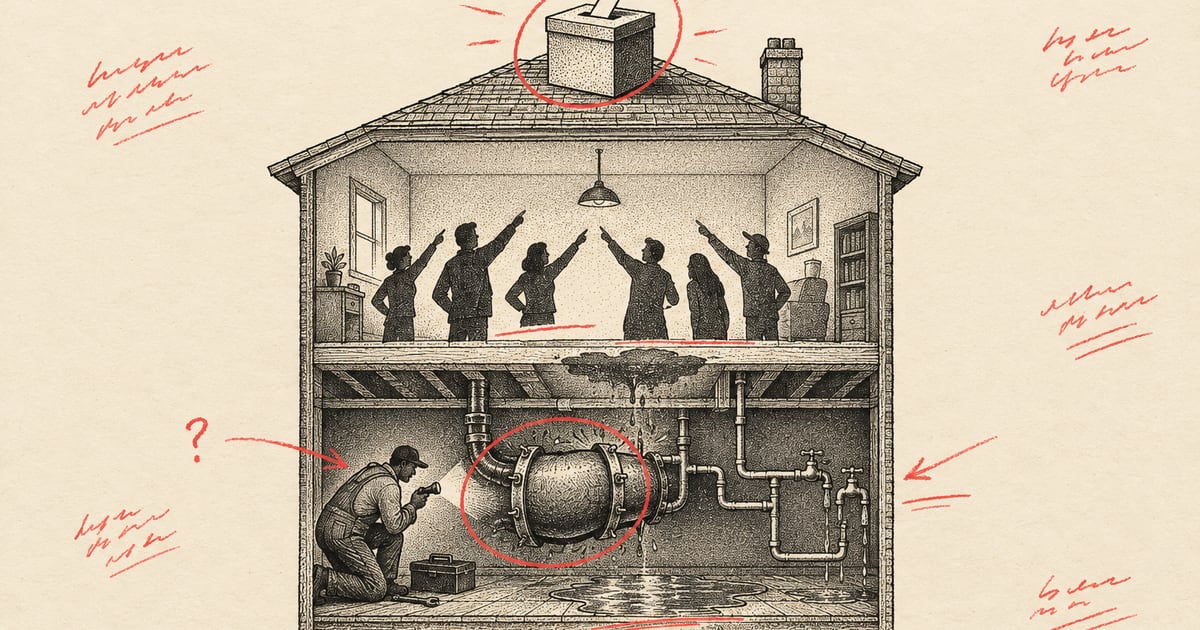
The week after the midterms, AI stocks had their worst stretch in years, and the press had its explanation ready: the election did it. The two best pieces I read this week both looked under that headline and came back with different stories. One reads the selloff as the market starting to separate AI winners from AI payers. The other reads it as a crowded, leveraged trade getting mechanically unwound. They can both be partly right. The question for anyone holding semis is which story describes your risk.
The AI Trade Deconstructed: AI Builders, AI Suppliers and AI Product firms!
Aswath Damodaran splits “the AI trade” into four groups: suppliers (chips, power, real estate), builders (hyperscalers), product companies (OpenAI, Anthropic), and customers. His argument is that shared optimism kept their interests aligned until now, and that they will diverge as the business matures.
Fact, as he reports it: AI stocks were 37% of US market cap going into November. On November 5 they lost almost $1.8 trillion in a single day. Chip stocks took most of the damage, while the hyperscalers gained in aggregate over the week.
if you are an investor of long standing in one of AI’s many winners, you should use each correction phase to sell a portion of your shares… If you decide to buy AI stocks after the correction, don’t wait for the bottom… set a trigger pricing or a valuation at which you would buy, and automate the process.
Interpretation: The key mechanism is that supplier revenue is the mirror image of builder capex. The same spending decision that drains a hyperscaler’s free cash flow shows up as a chipmaker’s earnings. That is why picks-and-shovels led on the way up. It is also why they crack first when shareholders start rewarding builders for restraint.
If the November 5 pattern holds, the reflexive loop has broken. That loop was simple: spend more, get marked up. Damodaran calls the over-investment “a feature, not a bug,” and the base rates support him. Railroads, fiber, and dot-com all followed that pattern.
Where I’d push: His scenarios skip a middle case. Demand could be real but concentrated, with a few enterprise uses monetizing well while consumer AI stays cheap. That outcome would split the product layer itself, not just separate suppliers from builders.
He also updates his Anthropic IPO math. Trimming two assumptions takes his equity value from about $1.5 trillion to $1.25 trillion. He attributes the trim partly to election-driven resistance to data centers. Note that one: it’s where he and the next writer part ways.
Quant Quake II? Thoughts on the Selloff
Barry Ritholtz describes the same week from the trading desk. The S&P 500 had its worst day since the April 2025 tariff shock. Semiconductors fell 12%, and $2.5 trillion disappeared faster than ever on record. He argues the cause was forced liquidation of crowded leveraged growth and semiconductor trades at multi-strategy “pod shops,” not the Democratic midterm win.
Fact: His timeline argument against the election story is clean. The result was known Tuesday night. Markets rallied Wednesday. No new political news arrived before Thursday’s drop.
He offers three plausible accelerants:
- a $500 million ING data center loan sale
- roughly $50 billion of leveraged ETF rebalancing
- drawdown-triggered unwinds across crowded quant pods, which he compares to the 2007 Quant Quake
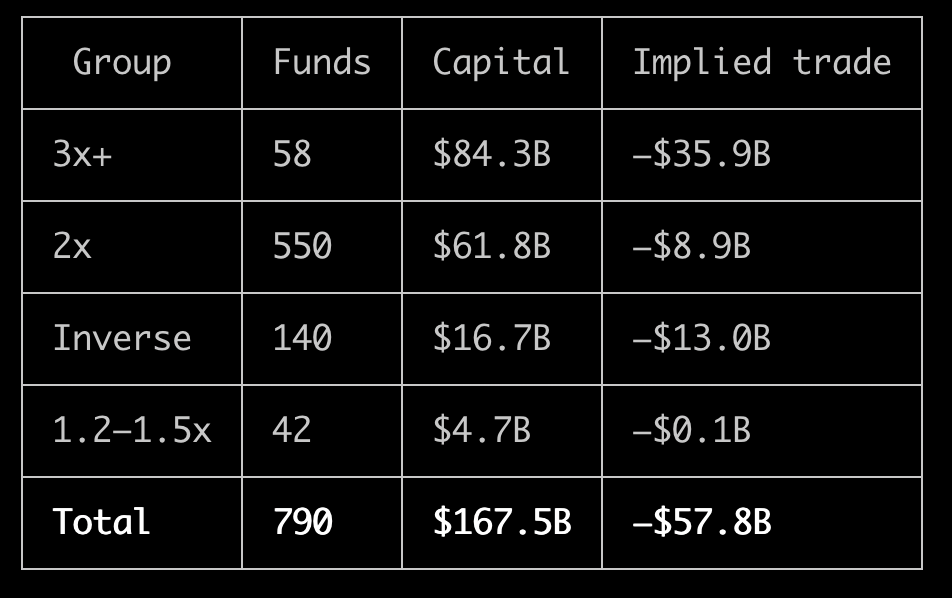
Hit a specific drawdown limit, and you trigger hard stops automatically.
Interpretation: I find the mechanics more persuasive than the politics. A $500 million loan sale is small next to the hundreds of billions the hyperscalers have already spent, and Ritholtz says so himself. His point is that a room full of crowded, levered positions only needs a small spark. In my notes I logged roughly 108 pods closed and the VIX up about 70%. I also noted that Nvidia had turned negative on the year after a run of 39%, 171%, and 239% annual gains.
Reconciling the two: Damodaran’s $1.8 trillion and Ritholtz’s $2.5 trillion are measured over different spans and different baskets. Don’t net them against each other.
The more useful point is that the explanations stack. Plumbing explains the speed. Damodaran’s supplier/builder split explains the shape: chips down, hyperscalers up. A pure forced-deleveraging story wouldn’t obviously produce that divergence.
Steelman for the press narrative: Data center permitting resistance is a slow-moving political risk. A leveraged book could reasonably decide to de-risk on it a day late.
Hype and Glory
This is from June, but it belongs next to the selloff pieces because it asks the question every crowded trade eventually faces: what has to be true? Paul Krugman looks at SpaceX’s post-IPO valuation, which is nearly equal to Microsoft’s and slightly above Amazon’s. He sets that against a $4 billion loss on $19 billion of revenue last year. His conclusion is that it’s a roughly $2.75 trillion meme stock.
The Starlink valuations in the SpaceX IPO imply that Starlink will eventually dominate 80% of the global internet service market. That’s not remotely possible.
Interpretation: The 80% market-share assumption is the part to attack. It’s an input to the valuation, not a forecast anyone has defended.
Where I disagree with Krugman is the Bitcoin comparison. He links SpaceX to Bitcoin’s unwind as a “Trump trade” built on political favoritism. SpaceX has real engineering assets and a business in Starlink, so “meme stock” overstates the case.
The structural point still stands. A valuation propped up by political access has a half-life tied to political capital. A crowded trade has a half-life tied to whoever is levered into it. In November we watched the second kind come due in semis.
Will Retiring Baby Boomers Crash the Stock Market?
On Ask the Compound, Ben Carlson takes on the bear case that retiring boomers will dump assets and sink stocks and housing. His rebuttal:
- Stock wealth is concentrated. In my notes, the top 10% hold 87% of stocks, so any selling arrives as a drip rather than a flood.
- RMDs often get reinvested rather than spent.
- 73 million millennials are entering their prime earning years, and much of the boomer wealth will be passed down rather than liquidated.
So much more money has been lost trying to time these market supercycles than has ever been gained by nailing it… Planning for a range of outcomes is always going to be more fruitful.
Why it’s here: It’s a calm counterweight to a loud week. The segment on discounting Ray Dalio’s crash calls is the useful part. Dalio has been warning of storms since 2015, while his actual book is built on diversification. Headline bearishness from people who have already made it reveals their positioning. It doesn’t predict much.
The same discipline applies to the selloff. Ritholtz’s own line is that it’s “very hard, even for genius physicists, to predict social panic.” Damodaran’s response to that problem is to automate the decision.
What I’m watching
- Hyperscaler capex guidance for Q1 2027. A deliberate slowdown would confirm Damodaran’s divergence thesis. It would also reverse the earnings tailwind suppliers have enjoyed.
- Anthropic’s actual IPO price versus Damodaran’s $1.25 trillion. It’s a live test of how much two assumptions move a trillion-dollar valuation.
- Leveraged ETF rebalancing as a recurring amplifier. If Ritholtz’s figure of roughly $50 billion shows up again in the next selloff, it’s structure, not coincidence.
- The counterparty side of the unwind. Any reporting on who absorbed the forced selling would test the pod-shop explanation better than price action alone.
The story the press tells about a selloff is free. The mechanism is what actually costs you money. —Dora 📈
Not financial advice. Do your own due diligence.