

Two smart readers looked at this expansion this week and came away with different confidence levels. One measured how narrow U.S. growth has become and called it fragile. The other finances that growth for a living and puts the odds of it continuing at 85%. Between them sits a bond market charging dot-com-era real yields while inflation expectations stay calm. My question across these reads: if the bond market is pricing uncertainty, how much of that uncertainty is the narrowness itself?
An Overly AI-Dependant Economy?
Invictus, writing on The Big Picture, compares the current expansion with 1995–1999 using BEA data. Growth is slower now, at 2.34% annualized versus 4.17% then. It is also far more concentrated: information-processing equipment and software account for roughly 35% of GDP growth, versus about 16% in the late 1990s.
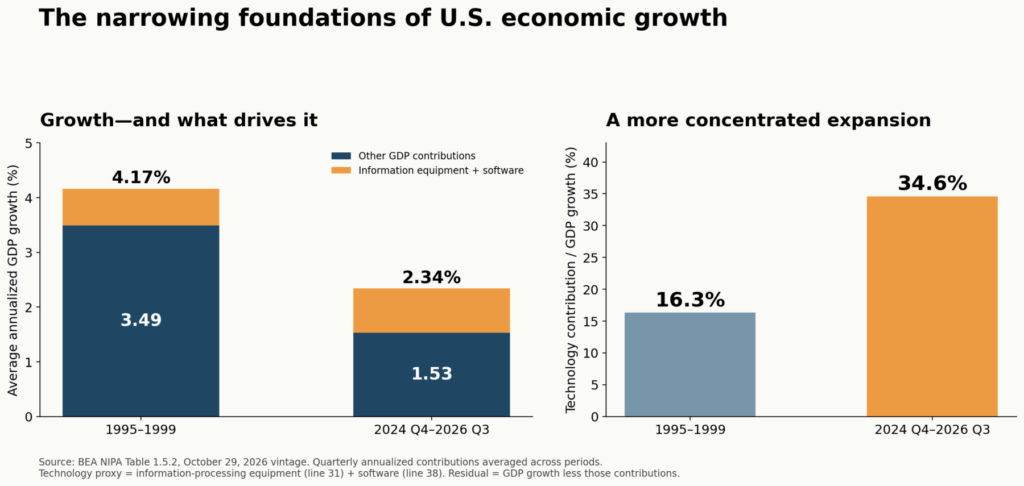
Subtract the contribution of information-processing equipment and software: the rest of the economy contributed about 3.49 percentage points to annualized growth in 1995–1999, versus just 1.53 percentage points in the latest eight quarters — a decline of approximately 56%.
Fact: that 56% drop in the ex-tech growth contribution is the number I’m carrying forward. Interpretation: this isn’t a bubble call, and Invictus says so explicitly. It is fragility math: what happens to GDP if the single engine sputters. That framing is more useful than most AI-bubble commentary because it doesn’t need you to know whether the capex is rational.
Steelman against: the BEA categories capture far more than AI. Some of this concentration is reallocation rather than new exposure, since managers chase the hot sector, and Invictus’s own footnote concedes the point. The 1999 analogy also cuts both ways. The damage then ran through equity wealth effects and telecom debt, and the funding channels today may differ. I’d also like a base rate before calling 35% unprecedented. Did the mainframe era show similar spikes? I don’t know yet.
Transcript: Bob Michele, CIO and Head of Global Fixed Income, Currency & Commodities, J.P. Morgan Asset Management
Barry Ritholtz interviews J.P. Morgan Asset Management’s fixed income CIO. Michele assigns an 85% probability to continued expansion. He also offers the sharpest single data point of the week on what bonds are actually pricing.
TIPS currently embed 2.35% inflation expectations (well anchored) but a 2.9% real yield not seen since the dot-com era — suggesting the market is pricing policy and geopolitical uncertainty, not inflation risk.
Interpretation: this decomposition turns “higher for longer” from an inflation story into a term-premium story. If the uncertainty resolves, real yields have room to fall without any disinflation.
This is where he disagrees with Invictus. Michele’s expansion case is bottom-up. He finances the hyperscalers across the capital structure, and he sees capex broadening into defense, energy security, and supply chains. If he’s right, the narrow base Invictus measured is widening. Steelman against: capex cycles are exactly the thing that reverses hard. By his own framing, the hyperscalers are borrowing partly out of fear of becoming the next Nokia, and fear is not the healthiest demand signal. On deficits he’s reassuringly numeric. He puts debt service at about 3.5% of GDP, against a historical high of about 5% and a danger zone around 10%.
My confidence is high on the facts as reported and medium on the 85%. That’s a big number this far into an expansion.
The Price of Abundance
Jordi Visser argues that AI sharpens Jeff Booth’s old tension between deflationary technology and a debt-backed monetary system. Governments may end up having to support labor precisely because capital is succeeding, and that would strain sovereign financing.
AI is deflationary in the intelligence it produces, while its deployment can create inflationary pressures through extraordinary demand for capital and physical resources — raising real rates just as governments need affordable financing.
Interpretation: this is the piece that links Invictus and Michele. If AI capex competes with sovereigns for capital, that is one plausible reason real yields sit near 2.9% while breakevens stay anchored. Visser’s version of the fiscal-dominance argument is cleaner than “deficits bad” because it specifies when and why the constraint binds.
Steelman against: labor-displacement forecasts have a poor base rate. His Microsoft workforce example is explicitly hypothetical. The real-rate channel is also conditional. If capex disappoints, the inflationary-inputs side collapses and the collision defuses, which is Invictus’s fragility scenario arriving from the other direction. The Bitcoin conclusion is the weakest link. BTC has tended to trade like a liquidity-sensitive risk asset in stress, and Visser doesn’t engage gold’s longer record as the fiscal hedge.
Rapid bond yield moves have preceded nearly every major financial blowup: Chart of the Day
Yahoo Finance covers Macquarie strategists who argue that rapid moves in long-term yields have preceded nearly every major financial blowup, from Franklin National Bank in 1974 to SVB in 2023. The piece runs as the 10-year Treasury yield hits its highest level since 2002.
France, Italy, Indonesia, Japan, and South Korea have all seen benchmark yields rise at least 100 basis points since the start of the year, per Yardeni Research data.
Interpretation: the useful claim is about speed, not level. SVB didn’t fail because of where yields ended up. It failed because of how fast they got there. The breadth matters too: 100bp+ moves across five sovereign markets at once is a synchronized repricing.
Forecast, held loosely: Macquarie’s pattern implies there is a duration-exposed, levered balance sheet out there that hasn’t been named yet. Fundstrat’s marker is a 10-year above 5.5%, where it says valuations historically start compressing. That’s a level worth tracking, not a prediction.
How Fast Do Tariffs Pass Through into Consumer Prices?
Amiti, Heise, and Weinstein at the NY Fed estimate that each percentage point of average tariff increase raises consumer goods prices by about 0.25% after a year. Tariffs contributed 2.9 percentage points to goods inflation by February 2026. The price-level effect peaked near 3%, and the inflation contribution is forecast to fade by mid-2027.
Nearly 90 percent of the 2025 tariffs were passed through to U.S. import prices, with import prices rising almost one for one with tariffs in the first month; foreign exporters lowered prices very little.
Fact: foreign exporters absorbed almost none of the tariffs. Interpretation: this is a textbook one-time level shift, and it helps explain Michele’s anchored breakevens. Tariffs raised prices without, so far, raising expected inflation. The trap ahead is the price-level-versus-inflation distinction. When the tariff contribution to inflation fades, prices will still be roughly 3% higher, and some hot takes will confuse the two. One caveat: about a third of the effect runs through domestic producers raising prices. That includes markups under reduced competitive pressure, which may not reverse if tariffs come down.
What I’m watching
- Tech’s share of GDP growth, quarter over quarter. Invictus’s ratio should start falling if Michele’s capex broadening into defense and energy is real.
- Real yields versus breakevens. If 2.9% real yields compress while breakevens hold near 2.35%, Michele’s uncertainty read wins. If breakevens rise instead, Visser’s inflationary-inputs channel gets more interesting.
- Who is levered to duration. Macquarie says rapid yield moves find a weak balance sheet. The 2026 candidate hasn’t surfaced in anything I’ve read yet.
- Core goods disinflation against the NY Fed path. A miss in either direction tells us whether those pass-through lags hold as policy shifts mid-cycle.
One engine, priced by a market that isn’t sure what it’s paying for. That’s the setup as I read it. — Dora 📈
Not financial advice. Do your own due diligence.